In frigid, plus five degree temperatures you can get a breeze on your hands when driving an electric bike. Many are equipped with these handle covers that keep the drivers' hands toasty.
Tuesday, December 30, 2008
Keeping Warm
In frigid, plus five degree temperatures you can get a breeze on your hands when driving an electric bike. Many are equipped with these handle covers that keep the drivers' hands toasty.
Thursday, December 18, 2008
Map of 加拿大
A friend pointed out a map of Canada (jiānádà) in the bookstore today. It was only ten yuan so I picked it up and have been figuring out the Chinese names of places I know and love. The map is a curious document, since some of the names are marked in English as well but many are not, and the Chinese names are definitely based on Mandarin pronunciation rather than Cantonese. Some towns, surprisingly, seem not to exist - Peace River is nowhere to be seen, though the associated body of water is labeled 皮斯河 písī hé. Grimshaw, or 各里姆肖 gèlĭmŭxiào, is on the map but Fairview (费尔维优 fèiĕrwéiyōu) is not. And some main highways are marked, but none are numbered.
艾伯塔 àibótă is Alberta, and of the many ways of translating Edmonton the clumsy 挨德蒙顿 áidémēngdùn is the most common. On a drive from the capital up to 曼宁 mànníng, a place name that slips quite easily into Chinese, you might stop at the A&W in 怀特考特 huáitèkăotè (Whitecourt), or hold on until 福克斯克里克 fúkèsī kèlĭkè (Fox Creek). Or you might decide to go through 奴湖村 núhú cūn - Slave Lake (village) instead.
Grande Prairie comes through as 大草原成 dàcăoyuán chéng, a translation, while further north we find 帕德尔普雷里 pàdéĕr pŭléilĭ - Paddle Prairie. Most lakes are not given the Chinese word for lake, but called láikè; for example, 威廉斯来克 wēiliánsī láikè - Williams lake. On the other hand, nearly every place name starting with 'Fort' translates it; Fort Mac is 麦克默里堡 màikèmòlĭ băo, Fort Sask is 萨斯喀彻温堡 sàsīkāchèwēn băo. I was curious to see the names of places like Medicine Hat and Moose Jaw, but they are just transliterated - 梅迪辛哈特 méidíxīn hātè and 穆斯乔 mùsīqiáo. Brooks is 布鲁克斯 bùlŭkèsī.
艾伯塔 àibótă is Alberta, and of the many ways of translating Edmonton the clumsy 挨德蒙顿 áidémēngdùn is the most common. On a drive from the capital up to 曼宁 mànníng, a place name that slips quite easily into Chinese, you might stop at the A&W in 怀特考特 huáitèkăotè (Whitecourt), or hold on until 福克斯克里克 fúkèsī kèlĭkè (Fox Creek). Or you might decide to go through 奴湖村 núhú cūn - Slave Lake (village) instead.
Grande Prairie comes through as 大草原成 dàcăoyuán chéng, a translation, while further north we find 帕德尔普雷里 pàdéĕr pŭléilĭ - Paddle Prairie. Most lakes are not given the Chinese word for lake, but called láikè; for example, 威廉斯来克 wēiliánsī láikè - Williams lake. On the other hand, nearly every place name starting with 'Fort' translates it; Fort Mac is 麦克默里堡 màikèmòlĭ băo, Fort Sask is 萨斯喀彻温堡 sàsīkāchèwēn băo. I was curious to see the names of places like Medicine Hat and Moose Jaw, but they are just transliterated - 梅迪辛哈特 méidíxīn hātè and 穆斯乔 mùsīqiáo. Brooks is 布鲁克斯 bùlŭkèsī.
Tuesday, December 16, 2008
Waiting for the bus
Monday, December 8, 2008
Three Wheelers
Outside the market.
My area is well served by the independent drivers on three wheelers - the san lun che. They hang around the gates of large apartment complexes and outside markets and are about the same cost as a cab. When my foot was bad I used them a lot to get around for short distances and got to really like riding with the open air street's eye view as well as the way they efficiently navigate all the little side streets and shortcuts. During rush hour the san lun che are faster than cabs because they can travel in the bike lanes. They are great for covering short distances in a hurry or for when your optimal bus stop is a kilometer or more away.
A few weeks ago as I left the market there were several drivers waiting for customers, including a few of the faster electric powered trikes and one older woman on a pedal only model. I decided to give the older woman some business, and was about three feet away when I realized she had only one arm. I must have stood for a few seconds with a 'hey, she has no arm' look on my face because she repeatedly assured me the lack of arm was no problem and brought me home.
Saturday, November 22, 2008
Cultural scenes
I couldn't resist posting another scenery picture though.
As far as I could figure out from the explanation, this woman is wearing not a scabbard, but a hook for holding a milk pail when a yak is milked.
Old mill.
Outside one of the temples.
Tib*tan sky burial area (where the dead are left for the birds).
Thursday, November 13, 2008
It Really is That Beautiful
The name 'Jiuzhaigou' is often pronounced with a sense of wonder; it's said to have some of the beautiful lakes in the world. I had researched going there before but the more details I learned, the more I hesitated - 300 rmb entrance fee, an additional mandatory bus fare to ride between scenic sites once you get in, ten thousand visitors per day ... didn't sound like a good time. When a friend invited me on the tour I accepted because I wanted to see Huanglong and had lower expectations for our day in Jiuzhaigou. (Our trip was mid week and not during a regular holiday, so even though there were lots of people there it didn't feel too crowded.)
We arrived as the morning fog was burning off:
The squirrels here are adorable, with stripes and little tufted ears.
Water, snow, rocks, and autumn colours blend into some of the loveliest natural scenes:
This lake has fish, and is so clear you can see the light shining through their fins.
These are the tour buses that you ride between scenic areas. It is possible to walk, but it takes much longer to get through.
Waterfalls:
The shot every Jiuzhaigou visitor has to get:
Back in Canada I had heard Chinese people say that the Canadian Rockies are OK but mountains in China are way more beautiful. I'd always dismissed this as homesickness, but now am beginning to understand.
Wednesday, November 12, 2008
The tour package, Chinese style
Near Huanglong:

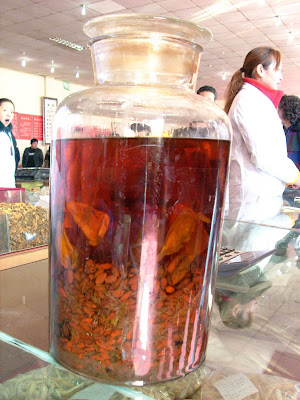
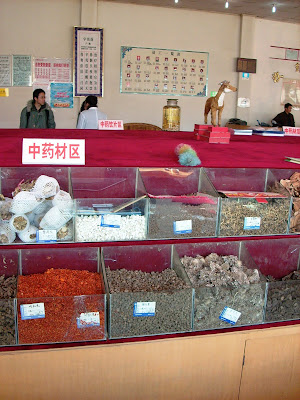
We spent 1800 rmb each for our tour which included flights, entry tickets, hotel and all meals except for one lunch for two days. The same level of tour but designed for foreigners I have seen for one to two thousand American dollars. It was well worth the cost but a tour designed for Chinese travellers has some unique features. For instance, along the bus route are mandatory shopping stops. The first was at a Chinese medicine store. They were selling the usual collection of unidentifiable things, and there was a guy with a tray of bloody, freshly hacked off antlers that could be bought by weight. They had several concoctions that could be steeped in alcohol. We tried this mixture which was supposed to be good for the brain:
Many places that sell Chinese medicine have the highly un-ecologically correct feature of a stuffed baby deer. (Just a guess, but I think it is related to the healing power of deer antlers.)
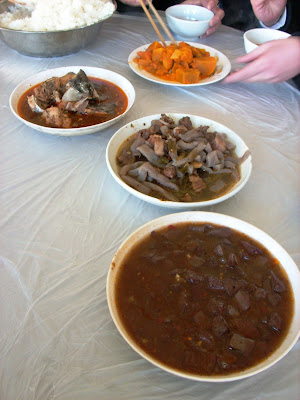
During the bus ride our guide who was local and spoke thickly accented Mandarin told stories, introduced features of the area, and taught us a few words in Tibetan. Before our first meal stop, he took some pains to explain that the food available was not going to be very good (short growing season for vegetables, and the earthquake had closed roads so tough to get things shipped to the area.) But that is no excuse for bad cooking.
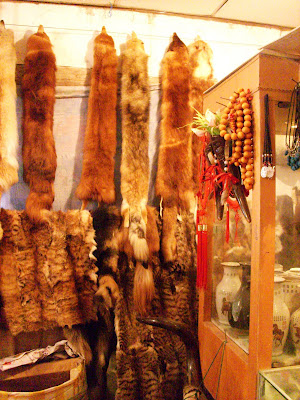
Pelts of these long, sharp faced animals that I can't identify were in many stores, both winter and summer coloured.
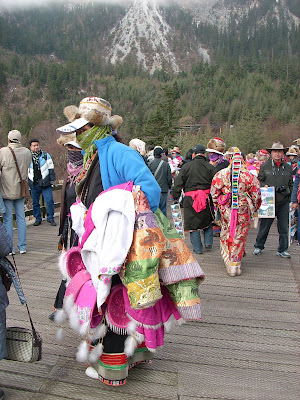
Our first bus stop in Jiuzhaigou featured many local people with costumes for us to try on - they literally line up and surround you as you get off the bus. To try on a costume is 10 rmb, if you get them to take your picture it is much more expensive. I was basically dressed in a costume (my hat pulled off and replaced with a tib*tan coloured and fringed cap; my arms pulled into sleeves of the dress) before I could protest.
The hotels at Jiuzhaigou (our guide claims all hotels are like this) have hot water at certain times of the day; in the evening between 8 and 11:30 and in the morning from 6 to 10 or so. The morning of our departure, we got a 5:30 wake up call and had to be on the bus before six. Yes, before the hot water was turned on. My problem with this, is that the trip back to the airport included two more mandatory shopping stops (you are required to get off the bus) that took up more than an hour.
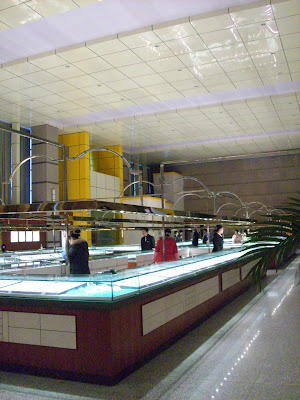
7 am shopping stop at a jewellery store. When was the last time you shopped for jewellery at 7 am?
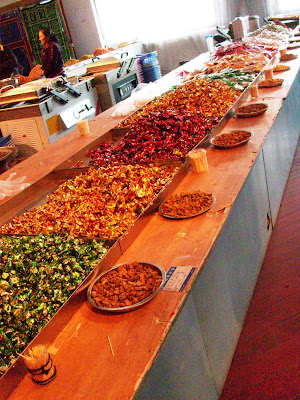
The next shopping stop was at a yak meat store. There were many interesting preparations of yak meat and other parts of the yak. I was kind of disinclined to buy anything after having been woken up so early though.
We spent 1800 rmb each for our tour which included flights, entry tickets, hotel and all meals except for one lunch for two days. The same level of tour but designed for foreigners I have seen for one to two thousand American dollars. It was well worth the cost but a tour designed for Chinese travellers has some unique features. For instance, along the bus route are mandatory shopping stops. The first was at a Chinese medicine store. They were selling the usual collection of unidentifiable things, and there was a guy with a tray of bloody, freshly hacked off antlers that could be bought by weight. They had several concoctions that could be steeped in alcohol. We tried this mixture which was supposed to be good for the brain:
Many places that sell Chinese medicine have the highly un-ecologically correct feature of a stuffed baby deer. (Just a guess, but I think it is related to the healing power of deer antlers.)
During the bus ride our guide who was local and spoke thickly accented Mandarin told stories, introduced features of the area, and taught us a few words in Tibetan. Before our first meal stop, he took some pains to explain that the food available was not going to be very good (short growing season for vegetables, and the earthquake had closed roads so tough to get things shipped to the area.) But that is no excuse for bad cooking.
Pelts of these long, sharp faced animals that I can't identify were in many stores, both winter and summer coloured.
Our first bus stop in Jiuzhaigou featured many local people with costumes for us to try on - they literally line up and surround you as you get off the bus. To try on a costume is 10 rmb, if you get them to take your picture it is much more expensive. I was basically dressed in a costume (my hat pulled off and replaced with a tib*tan coloured and fringed cap; my arms pulled into sleeves of the dress) before I could protest.
The hotels at Jiuzhaigou (our guide claims all hotels are like this) have hot water at certain times of the day; in the evening between 8 and 11:30 and in the morning from 6 to 10 or so. The morning of our departure, we got a 5:30 wake up call and had to be on the bus before six. Yes, before the hot water was turned on. My problem with this, is that the trip back to the airport included two more mandatory shopping stops (you are required to get off the bus) that took up more than an hour.
7 am shopping stop at a jewellery store. When was the last time you shopped for jewellery at 7 am?
The next shopping stop was at a yak meat store. There were many interesting preparations of yak meat and other parts of the yak. I was kind of disinclined to buy anything after having been woken up so early though.
Subscribe to:
Posts (Atom)